Example Budgets
Six fictional households, from severe scarcity to real wealth. Each one has a full plan, a balance sheet and six months of transactions - and you can open any of them and use the entire app with their numbers.
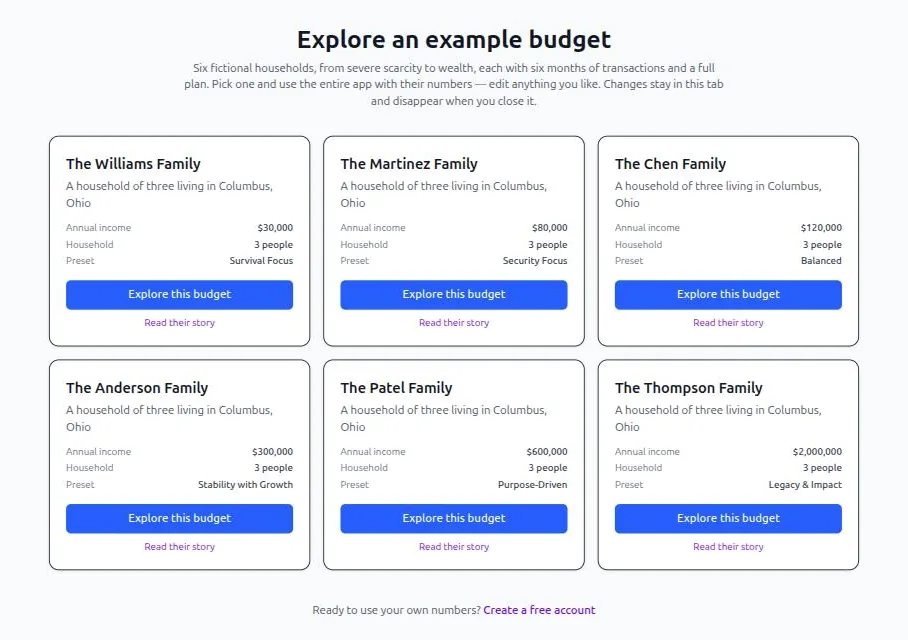
Read the story to see how they categorized their spending and what the hierarchy showed them. Then open the interactive budget and click around: edit anything, break anything, see how it reacts.
Your edits stay in that browser tab and disappear when you close it. Nothing is saved anywhere and no account is needed.
That also means there’s no way to turn an example into your own budget - the numbers belong to a household that doesn’t exist. When you’re ready for yours, start fresh with Getting Started.
The Williams Family
$30,000/year. Every dollar spoken for, no buffer, no room for error. What scarcity looks like on a hierarchy.
The Martinez Family
$80,000/year. Past the crisis point but not yet comfortable - building a foundation while debt still outweighs savings.
The Chen Family
$120,000/year. Doing everything right and still feeling a tension they can't name. The gap between intent and allocation.
The Anderson Family
$300,000/year. Basics secure, higher needs emerging. Struggling with meaning rather than money.
The Patel Family
$600,000/year. Lower needs optimized, premium everything - and a search for purpose the money doesn't answer.
The Thompson Family
$2,000,000/year. Every lower need solved. What the hierarchy looks like when only the top of it is still open.
Why Six
Because the framework claims something specific: that the person earning $40,000 and struggling with safety, and the person earning $400,000 and struggling with esteem, both feel broke - and both are right.
You can argue with that in the abstract. It’s harder to argue with six hierarchies side by side. The Williams family’s pyramid is bottom-heavy because it has to be. The Thompson family’s is inverted, with almost everything at the top, because their lower needs stopped asking. Neither is a better person. They’re at different points in the same structure.
See Philosophy for the theory, and the Interpretation Guide for reading your own.
Related Pages
- All example budgets - Pick one and explore
- Philosophy - The theory behind the hierarchy
- Interpretation Guide - Reading your own patterns
- Getting Started - Build your own